
Catching Clarity, Conferring, and Checklists Can Make Assessment Actionable

Updated: Apr 27

Assessment isn’t about us.
A student demands that a teacher be fired. What teacher, what happened? I can explain.
I work as a high school instructional coach by day and also teach a virtual class. My teaching certificate is still intact, and around 120 students a year have the opportunity to learn art history virtually in a course I teach outside of contract hours.
It is an awesome challenge as I have the full range of learners. The wicked motivated sophomores who are also in AP World History and want to gobble up all the information they can for that test, as well as the second semester seniors who are not graduating unless they pass their fine art credit in art history, having failed their first attempt at an in-person art class.
But back to a student who wants me fired. Yes, I am the teacher in question. This was a very uncommon experience for me. I spend my days with the teachers as the instructional coach, grading and giving feedback to my art history students at night. I even blog about improving educational practices through new best practices.
It is the ideal situation for me, still designing lessons and assessments, grading, emailing parents, and dealing with the learning management system changes, which increases my credibility among skeptical staff.
I rarely meet my art history learners in person. They do their thing and occasionally will seek me out in my office to say hi or apologize for late work, etc. Generally, my course runs itself in the background, and I do my day job as an instructional coach at a large Midwest comprehensive high school with over 2,200 students and 140 teachers.
Still, I put together a decent class in art history, so much so that they had to add staff to handle the course's popularity. Therefore, I was very eager to know why one of my students was so enraged that they were asking to have me dismissed.
When Clarity Changes Everything
Angela, a senior whose name has been changed for privacy purposes, did not understand the assignment in the virtual class I teach and wanted to even the score. Thankfully, an admin assistant flagged me down, and I met with Angela in the counseling center to unpack the issue.
As it happened, a conversation was exactly what she needed to move forward. I asked Angela to close her computer and look at me. Reluctantly and with daggers in her eyes, she did just that. I repeated my written directions in short bullet points. Step 1, Step 2, etc. The mood lightened tremendously, and she exclaimed, "Well, that is easy.” I agreed, and 20 minutes later, her submission was complete.
This was now a critical moment for me as an instructor. Do I think of Angela as the outlier? Do I dismiss her as a student who didn’t read the directions? Or do I take a look at my assignment through a new set of eyes and improve it? As an instructional coach, I would feel like a charlatan if I didn't choose improvement.
Clear is kind.
Chatting with Angela was an astute reminder of the level of frustration and anxiety that the unknown can produce in an adolescent. If we are being honest, it happens with adults as well. We all deserve clarity in our learning and tasks.
We all deserve clairty in our learning and tasks
I appreciated our interaction and rewrote the directions to mirror the conversation with Angela. I replaced the narrative with step-by-step instructions. I separated the whole into parts to make the assignment more accessible. Chunking a lesson into steps is not a habit that I use as a default.
Why not? My thought is that as a master of my content, I can write anything and it will make sense. Hattie and Clarke (2019) state that teachers are the evaluators of student learning, and all student learning is feedback for the teacher. Basically, we can get in our own way as teachers if we are too attached to an assignment or a lesson or our wording and not open to the feedback our learners give us, both overtly (Angela is a great example) and covertly, when a lesson falls flat.
Student learning is feedback for the teacher.
Luckily, I have also had that experience many times in my career and can coach a teacher into change when we discuss keeping student learning as our main objective.
A lesson that causes anxiety or confusion will lower the effectiveness substantially. That can turn into us spinning our wheels with students and teachers feeling overwhelmed. Seeking out feedback as a teacher around the concept of clarity can be awkward, or it can be a part of our habits.
At the end of each learning competency, I encourage teachers to put a list of assignments and assessments in front of their learners, along with the learning targets and skills.
There is so much value in asking the students, " Which of these lessons brought you closer to the target? Why do you think that is the case? Which of these assessments provided you with an opportunity to show what you know?"
Discussing the learning reveals how much clarity of understanding students were able to connect with and retain.
Discussing the learning reveals how much clarity of understanding students were able to connect with and retain.
To ground this in practice, here’s what this looked like in my art history class.
Reflect on the introductory unit. Did these short reading/research assignments help me get to know you as a reader and thinker? Reminder, our assignments included reading about how art influences the past, watching a video about online museums, an intro to art language, and a discussion about the benefits of studying art history. Our goals were as follows...Reading and thinking about art!
You can write a short reflection or record a short reflection. See options below. How did the intro unit help me get to know you as a reader and thinker? OR how did the intro unit stretch you as a reader or thinker? Do you have any questions for me? |
Here’s an example of a student response to that reflection:

Conferring as an Assessment
As a secondary teacher, conferring wasn’t a pinnacle in my toolbox until I found the power of achieving clarity one on one with students. As a K-12 coaching team, I have had the tremendous honor of working side by side with many of my elementary teacher colleagues and have found that they have a bank of assessment strategies that are not implemented in the land of secondary education.
Conferring is one of those golden ticket strategies that cannot be overutilized. I started reading everything I could get my hands on about the practice of conferring and bringing it up in every single coaching conversation I had for months.
Conferring is one of those golden ticket strategies that cannot be overutilized
I partnered with an ELA teacher and a Special Education teacher and brought the power of conferring into their toolbox of teacher strategies. My ELA teacher was worried about the amount of time it would take to get to all 30 students. My Special Education teacher was concerned about what the rest of the students would be doing.
We experimented with questions and cues, but both landed on the effectiveness of conferring one-on-one and in small groups. Serravallo (2023) explains that establishing a focus for the conversation is the first step. Creating a classroom that normalizes the routine of small groups and conferring conversations is the first step.
There is a misnomer in education, especially at the secondary level, that students won’t complete work that isn’t for a grade. We could spend a lot of time unpacking that overgeneralization, but time is better spent on creating scenarios in the classroom where a student succeeds every time.
Continuing with the need for clarity, if a student is clear on the question and it is understood that participation is feedback for both the instructor and the learner, some robust conferencing can take place. I always recommend extremely psychologically safe material to develop this classroom routine.
This might look like:
Start with a small group conversation. Small groups chatting at will about a current event, or the weekend, or their favorite animal is a solid first step.
Establish success criteria for the group. Establishing success criteria for the small groups provides clarity and a partnership between everyone involved. Maybe it is important that everyone has a chance to speak before anyone chimes in twice. It could just as easily be a silent protocol with whiteboards.
Focus on connection through conferring. The key to making conferring valuable is the connection between the students and the teacher. Once the routine is established, you can fold in content seamlessly and pull groups with similar needs.
Encourage participation through small successes. This is where I like to encourage teachers to give a participation or attempt grade. Each and every student has the opportunity for a small success in their academic day.
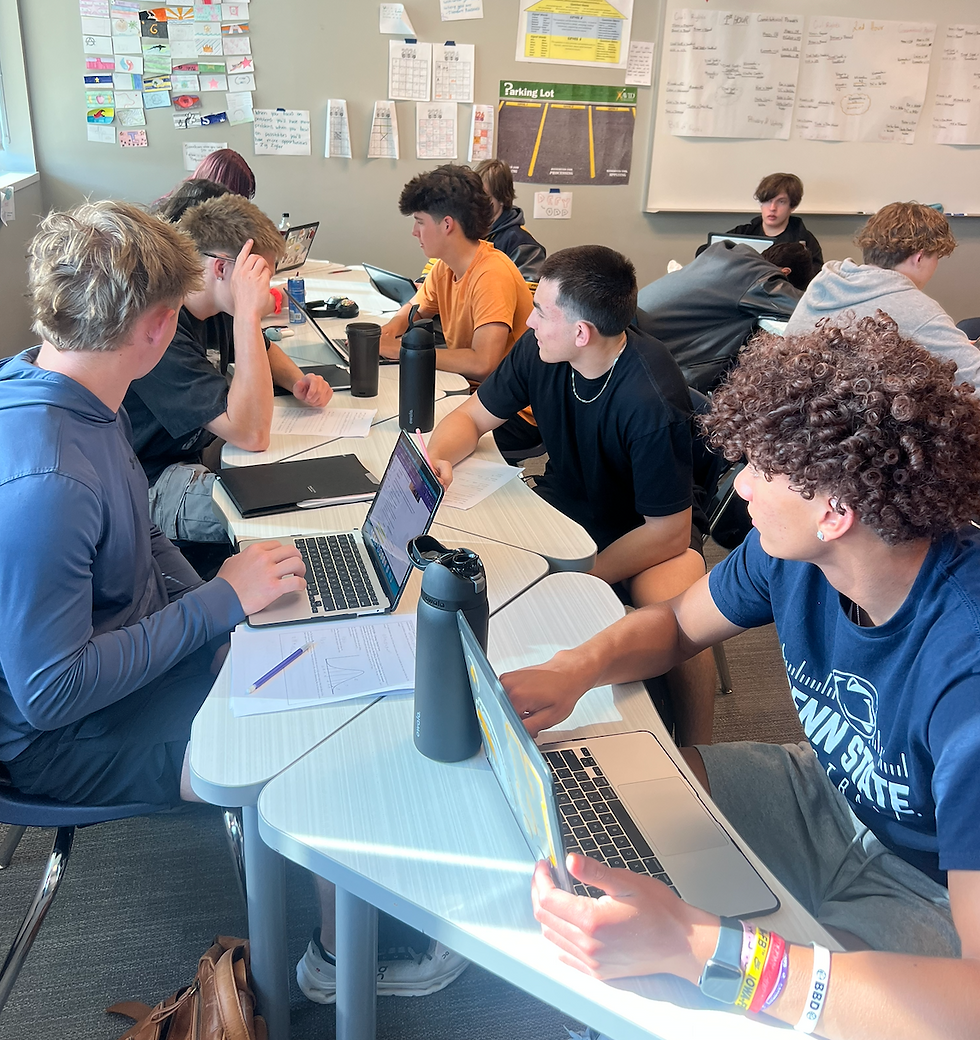
Students participating in a collaborative conversation about economic policies across nations. Source: Stephanie Marks from Liberty North High School, American Government class. Shared with permission
I would be remiss if I didn’t address the teachers' concerns. There were times when learners not at the table were off task. We did encounter a hiccup when the rest of the class was unclear about how to react to the teacher in the back of the room, with only a few students.
We kept the conversation going and tried traveling. Proximity to all and powerful conversations with one. With varying approaches, each of my teachers found a flow by conferring once a week. Occasionally, the schedule would shift, and conferring would be cut short or canceled for the week.
However, the practice came back around as one of the most powerful on the spot assessments of learning which they both valued tremendously. Connecting with learners is always time well spent.
Connecting with learners is always time well spent
Acknowledging their time and tossing a few points in the gradebook was effortless. And as it turns out, a research based practice that enhances the learner experience for any student with ADHD.
Checklists For Good
As a narrative thinker, I am often guilty of a paragraph when a sentence will do. After extended time with one of my special education teachers, I was brought up to speed that a list is a much more friendly format for many neurodivergent learners.
Over the last six years, I have learned more about ADHD and learners with divergent needs than I would venture with most coaches in a similar role. Working with several special education teachers left me thirsty for the level of understanding that I could articulate to regular education teachers frustrated with mounting 504’s for anxiety and ADHD.
The statistics are staggering. Current research estimates that there are 20-40% of the population not diagnosed and that between 4-7 million school age children have ADHD (Barkley, 2020).
It was time for me to know more, model more, and implement more for my teachers and the students who would benefit from better pedagogical practices.
There are far too many myths about ADHD than there are answers and practices that support an attainable education for our learners with an executive functioning deficit. There is an educational shift that can happen and benefit the masses of learners.
I learned this lesson with Angela. Providing a checklist is a friendlier option than giving directions in a narrative. For our neurodivergent learners, one day, one direction is probably the best approach. This may disrupt your gradebook, but I think it is worthwhile.
Providing a checklist is a friendlier option than giving directions in a narrative
Students with ADHD are prone to panic when approached with an upcoming three week project. My special education experts have taught me to coach up our teachers with another approach. Lean into what is happening in the first 15 minutes, then the second, until the end of the learning time.
Keeping a student with ADHD or any student without a fully formed prefrontal cortex (which is all of them) engaged is a tall order. Motivation is an effort, sustained motivation is an extremely, next to impossible task for a student with ADHD.
It isn’t that our directions aren’t great, they literally won’t stay in the working memory of a student with ADHD. It is less about forgetting and more about not sticking.
It is less about forgetting and more about not sticking
The thing I have been coaching people on the most is not taking a learner not knowing what to do as a personal attack. The student in question literally can’t remember due to the developmental and neurological nature of their brain (Barkley, 2020).
There are a few ideas that will create more friendly neurodivergent assessment environments. These ideas can be implemented for all our students, not just those with an IEP or a 504.
Turn a longer project into small assignments.
Utilize a timer to make a physical reminder
Take brain breaks for executive functioning resets
Rewrite your narrative into bullet points
Hold learners accountable to reasonable expectations
Everyone can increase their executive functioning by taking a quick walk or meditation to take a break from a screen and to reboot and refresh their thinking (Barkley, 2020). When we translate these ideas into practice, clarity becomes visible and can often be achieved through something as simple as a checklist. Here’s what this looks like when a larger assignment is broken into a clear, student-friendly checklist.

Rethinking Assessment from Grading to Learning
Grading has never been a reason that anyone on earth decided to become a teacher. It is, however, in our best interests to know what our learners can do throughout the learning process.
Grading has never been a reason that anyone on earth decided to become a teacher
Teachers are among a group of specialized professions that aren’t always open to feedback or change, often leading to spending a tremendous amount of time on the wrong items.
Let's start to think about assessment as endless possibilities. Feedback is assessment, instruction is assessment, discussion is assessment, and unpacking steps and schema of learning as assessment. Our goal is to assess and progress quickly, demystifying misconceptions and uncovering rather than “covering” content.

For example, a Venn diagram is often used as an in-class activity, but it can also serve as an effective assessment tool for analysis and connection-making. The example to the right is from one of my teachers of a US Government class. Students captured their thinking on how countries with different economies prioritize limited resources using this method, and the teacher could check their understanding. By structuring it properly, we can collaboratively gather evidence of critical thinking.
Actionable Assessment in Practice
Actionable assessment, including checklists, conferring, and increasing clarity, will save time. Huge comprehensive finals that are autopsies of the unit's dead and buried are a thing of the past.
Actionable assessment, including checklists, conferring, and increasing clarity, will save time.
Teaching and learning is complex. Each learner is unique. Dr. Gawande (2009) describes the problem of deep complexity and proposes solutions which involve a growth mindset. Change is the only constant in education.
Rethinking traditional assessment is happening throughout higher education. There is an old phrase in education that what gets checked gets graded and what gets graded gets done.
Making decisions regarding how learners spend their time is real. Our students can spend time copying and pasting or using AI to think for them, or we can set the bar higher and create daily experiences that let them practice the fundamentals and then apply them to complex problems.
We can set the bar higher and create daily experiences that require real thinking.
We have only our own cognitive flexibility or inflexibility to try out a new paradigm, like a checklist, and incorporate it into our actions.
Please note: All images in this blog are shared with permission from the school and participants. These images may not be reused or reproduced without written consent.
Citations:
Barkley, R. A. (2020). Taking charge of ADHD: The complete authoritative guide for parents (4th ed.). Guilford Press.
Gawande, A. (2009). The checklist manifesto: How to get things right. Metropolitan Books.
Hattie, J., & Clarke, S. (2019). Visible learning: Feedback. Routledge.
Serravallo, J. (2023). Teaching reading across the day. Heinemann.
Serravallo, J. (2023). The reading strategies book 2.0: Your research-based guide to developing skilled readers. Heinemann.
At ACP, we are committed to transparency in our content creation. Learn more in our AI Policy.


Comments